API Documentation Automation
This folder contains the configuration and workflow setup for automated validation and documentation of the OpenAPI specifications.
My setup includes:
-
GitHub Actions Workflow that:
- Validates OpenAPI 3.0 specifications with Spectral.
- Generates static API reference documentation using Redocly CLI.
- Deploys the generated documentation to GitHub Pages on every commit to the
mainbranch.
-
Documentation Hosting:
The generated docs are published automatically and can be accessed via GitHub Pages -
Custom Landing Page:
Anindex.htmlfile was generated automatically in the workflow. It links to the API reference docs and the GitHub repository, and it was customized to use Chimoney as a case study.
Rules and Standards Enforced
-
Spectral Linting:
- Ensures OpenAPI 3.0 specifications follow best practices.
- Common enforced rules:
- Every operation must have a
summaryanddescription. - Operation IDs must be unique.
- Paths must begin with
/. - Schema objects must have
typedefined. - Responses must include at least one
2xxsuccess code.
- Every operation must have a
-
for Vale linting:
- Enforces consistent style and grammar in API descriptions and documentation.
- Example standards:
- Avoids weak words like “just” or “simple”.
- Enforces sentence case for headings.
- Consistent spelling (e.g., “email” not “e-mail”).
Workflow execution
Below is a screenshot showing the GitHub Actions workflow in action. The automated pipeline validates the OpenAPI specification, generates documentation, and deploys it to GitHub Pages.
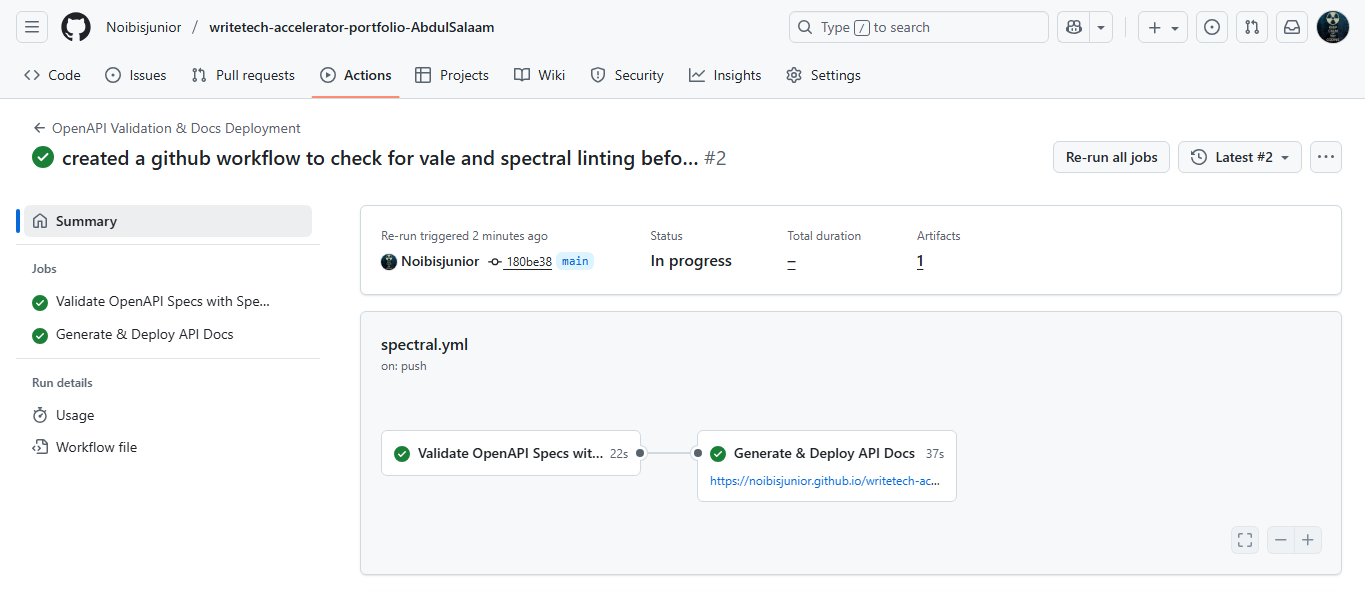
The workflow successfully validates the OpenAPI spec with Spectral, builds documentation with Redocly, and deploys to GitHub Pages.
Challenges faced and solutions
Building an automated documentation pipeline involved overcoming several technical challenges. Here's how I resolved the key issues encountered during implementation.
GitHub Pages deployment error
Problem: The initial workflow deployment failed with the following error:
Error: Get Pages site failed. Please verify that the repository has Pages enabled and has a valid source configured.
Root cause: GitHub Pages was not configured to use GitHub Actions as the deployment source.
Solution:
- Navigate to repository Settings → Pages.
- Under "Build and deployment," change Source to GitHub Actions.
- Re-run the workflow.
This configuration allows GitHub Actions workflows to deploy directly to Pages without requiring a separate branch.
Spectral configuration
Problem: Understanding which Spectral rules to enable and how to create custom rules for API-specific requirements.
Solution: Started with the default spectral:oas ruleset and gradually added custom rules. Used the Spectral documentation to understand JSONPath selectors and rule functions.
Vale style guide setup
Problem: Configuring Vale to use the correct style guides. The initial .vale.ini configuration had an incorrect path: StylesPath = /.github/styles.
Solution: Fixed the configuration by changing it to StylesPath = .github/styles (removing the leading slash). This resolved path resolution errors and allowed Vale to find the style guides correctly.
Key learnings
This project provided hands-on experience with modern documentation automation practices and CI/CD workflows. Here are the key technical skills and insights gained.
1. CI/CD for documentation
I learned how to implement continuous integration and deployment pipelines specifically for documentation. GitHub Actions enables automated validation and deployment on every code change, ensuring documentation is always current and accurate.
Key insight: Automating documentation deployment eliminates manual publishing steps and reduces human error. Every commit triggers validation, ensuring broken documentation never reaches production.
2. Importance of standards and validation
Spectral enforces OpenAPI specification quality, while Vale ensures documentation readability and consistency. These tools catch issues that human reviewers might miss, such as:
- Missing operation descriptions
- Inconsistent terminology
- Grammar and style violations
- Incomplete API schemas
By automating these checks, documentation quality improves significantly while reducing review time.
3. OpenAPI specification best practices
Working with Spectral taught me the importance of well-structured API specifications. Complete, accurate OpenAPI documents enable:
- Automated documentation generation - Tools like Redocly can build beautiful docs automatically
- Code generation - Client SDKs and server stubs can be generated from the spec
- Contract testing - Automated tests can validate that implementations match the specification
- Interactive documentation - Users can test API endpoints directly from the docs
4. Troubleshooting GitHub Actions
I gained practical experience debugging CI/CD workflows, particularly around:
- Permission configuration for GitHub Pages deployment
- Workflow dependencies and job ordering
- Artifact management and file path handling
- Environment variables and secrets management
Understanding GitHub Actions logs and error messages was crucial for identifying and fixing deployment issues quickly.
Conclusion
This module demonstrates how automation transforms documentation from a manual, error-prone process into a reliable, efficient pipeline. By integrating Spectral, Redocly, Vale, and GitHub Actions, I created a system that ensures API documentation is always validated, consistently styled, and automatically deployed.
Benefits of this automation approach:
- Quality assurance - Automated validation catches errors before they reach users
- Consistency - Style guides enforce uniform terminology and formatting
- Efficiency - Automatic deployment eliminates manual publishing steps
- Reliability - Every change is tested and validated before deployment
- Scalability - The same pipeline can validate hundreds of API endpoints
This automation infrastructure reduces documentation maintenance overhead while improving quality, making it an essential practice for modern technical writing teams.